
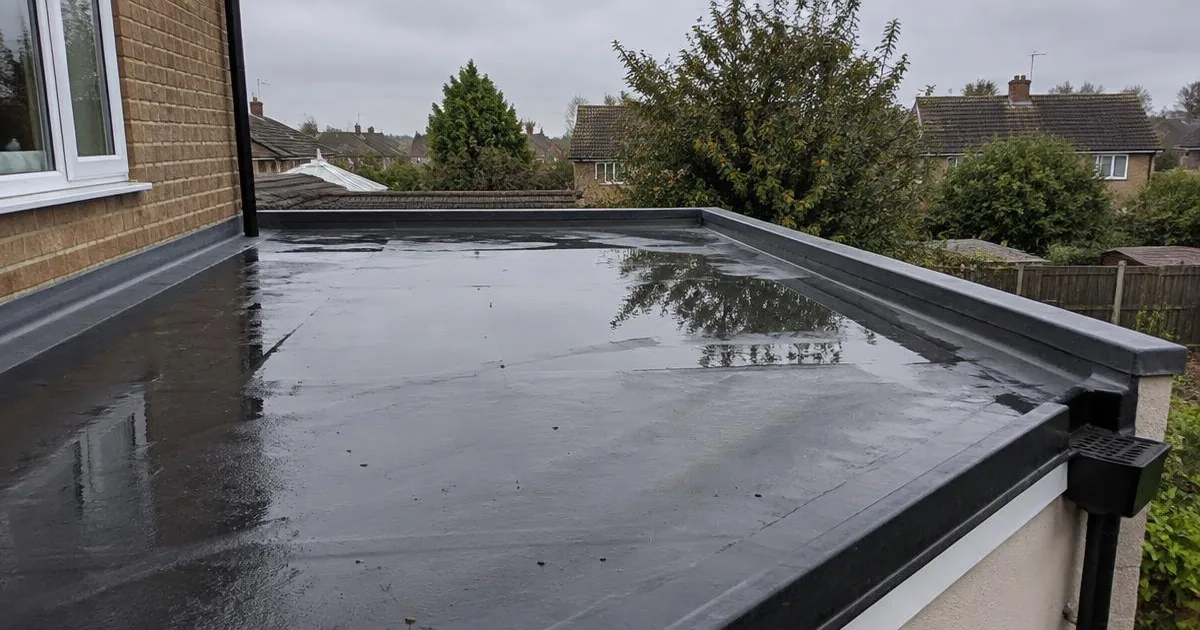
A leaking or damaged flat roof does not automatically need replacing. If the problem is confined to one area and the rest of the roof remains sound, a professional repair may provide a perfectly sensible solution.
Replacement becomes more likely when damage is widespread, water repeatedly gets in, the covering is deteriorating across several areas or previous repairs are beginning to accumulate.
The right decision depends on why the flat roof is failing and what condition the complete roofing system is in.
What can go wrong with a flat roof?
Despite the name, a properly designed flat roof is not simply a completely level surface.
It needs to manage and drain rainwater effectively.
Potential problems can include:
- splits or cracks
- punctures
- damaged joints
- failed edges
- flashing defects
- deterioration around outlets
- problems around vents or penetrations
- standing water
- movement in the roof covering
- ageing materials
- previous repairs beginning to fail
Different flat-roof systems develop different types of problems, so identifying the existing material is part of assessing the best repair.
When can a flat roof usually be repaired?
The damage is confined to one area
A local defect may be repairable where the remainder of the roof remains sound.
Examples may include:
- an isolated puncture
- local cracking
- one failed detail
- minor flashing damage
- damage around a penetration
The surrounding material needs to be capable of accepting and supporting an effective repair.
The roof is otherwise in good condition
A repair makes much more sense where the problem is exceptional rather than part of general deterioration.
For example, accidental damage to an otherwise serviceable roof can be very different from a roof covering that is failing in several places because of age or poor installation.
The source of the leak can be identified
A targeted repair works best when there is a clear defect to address.
This might be:
- damaged flashing
- a split
- a problem around an outlet
- a local joint failure
Simply coating or patching the area where water appears inside does not necessarily solve the actual problem.
When might replacement make more sense?
Repairs keep failing
If a flat roof develops one leak after another, continuing to add patches may eventually become poor value.
Repeated defects can indicate that the underlying roof covering is deteriorating more widely.
There are patches everywhere
Previous repairs are not automatically a problem.
But a roof covered in different patches can indicate that individual areas have been failing progressively.
At some stage it becomes sensible to ask whether repairing the next defect is extending the useful life of the roof or simply postponing replacement.
The covering is deteriorating across a large area
Replacement becomes more likely when there is widespread:
- cracking
- splitting
- blistering
- lifting
- separation
- movement
This is different from one isolated defect.
Water regularly sits on the roof
Some temporary standing water after heavy rain may not necessarily indicate immediate failure.
However, persistent pooling can point to drainage or roof-design issues.
If water repeatedly collects in the same areas, it is worth investigating:
- falls
- outlets
- structural movement
- roof deck condition
Simply repairing the surface may not address the underlying reason water is accumulating.
There are problems beneath the roof covering
Sometimes visible membrane damage is only part of the issue.
Water ingress can affect:
- insulation
- decking
- timber
- internal finishes
If underlying components have deteriorated, more extensive work may be required than simply repairing the outer surface.
Why is my flat roof leaking?
Common potential causes include:
- ageing materials
- physical damage
- failed joints
- flashing defects
- poor detailing
- blocked drainage
- damage around penetrations
- movement
- previous repairs deteriorating
As with a pitched roof, the place where water appears inside may not be immediately below the external defect.
Water can travel beneath the roof covering before becoming visible.
Why does my flat roof leak only during heavy rain?
Heavy rain can expose weaknesses that normal rainfall does not.
A vulnerable area may cope with lighter rain but allow water in when:
- rainfall becomes prolonged
- water begins pooling
- drainage struggles
- wind drives water into vulnerable details
A leak that occurs only during severe weather should still be investigated.
It may be an early sign of deterioration.
Is standing water on a flat roof normal?
Flat roofs need enough fall to direct water towards drainage points.
Small amounts of moisture may remain temporarily after rainfall.
Large areas of water that remain for extended periods deserve closer attention.
Persistent ponding may increase the demands placed on the roof covering and can indicate that water is not draining as intended.
Can a flat roof be patched?
Yes, in suitable circumstances.
A properly specified local repair can be appropriate for isolated damage.
The important distinction is between:
- a repairable defect in an otherwise sound roof
- and a failing roofing system being repeatedly patched
That is why the condition of the surrounding material matters.
Should I repair or replace an old flat roof?
Age is only part of the decision.
Consider:
- how many problems have occurred
- whether previous repairs are still performing
- whether water is getting in repeatedly
- whether damage is localised or widespread
- the condition of the substrate beneath
- whether drainage is working properly
An older flat roof that remains sound may not need replacing purely because of its age.
Equally, a relatively recent roof can require significant work if it was poorly installed.
What type of flat roof do I have?
Common flat-roof systems found on UK properties include various forms of:
- felt roofing
- GRP fibreglass
- single-ply or rubber-type membranes
- other modern membrane systems
Different systems need different repair techniques.
It is therefore useful to identify what has been installed before deciding how a defect should be treated.
What should a flat-roof inspection look at?
A proper assessment may consider:
- surface condition
- joints
- seams
- edges
- flashing
- drainage outlets
- penetrations
- standing water
- previous repairs
- roof deck condition
- internal signs of water ingress
Looking only at the visible leak can miss the broader cause.
Can a leaking flat roof damage the property underneath?
Yes.
Continued water ingress may affect:
- ceilings
- insulation
- timber
- roof decking
- decoration
- electrical areas
This is why a flat-roof leak should not simply be ignored because the amount of water currently seems small.
What should I do if my flat roof starts leaking?
If water is entering:
Protect the room below
Move furniture and valuables where possible.
Contain dripping water
Use a suitable container if safe.
Photograph the problem
Photograph visible internal damage and the roof from ground level where possible.
Don't walk onto the roof
Arrange an assessment
The next step is identifying the actual source and understanding the overall condition of the roof.
Is replacing a flat roof better than continuing to repair it?
Not automatically.
If a sound roof develops one repairable defect, replacement may be completely unnecessary.
But if you are repeatedly spending money on separate repairs, it is worth considering the total cost rather than viewing every repair independently.
The useful question is:
Will this repair provide a sensible longer-term solution?
If the answer is increasingly uncertain because the whole covering is deteriorating, replacement deserves consideration.
Flat roofing in Blyth and Northumberland
Hewitson Roofing provides flat-roof repair, replacement and installation services from our base in Blyth, Northumberland, working throughout Northumberland and surrounding areas of the North East.
We can assess:
- flat-roof leaks
- damaged coverings
- local defects
- flashing
- drainage issues
- ageing flat roofs
- replacement requirements
If you're not sure which roofing system you have or whether repair is still worthwhile, that's fine.
The starting point is simply assessing what is already there.
For more on the broader repair-or-replace question, read our guide on whether your roof needs repairing or replacing, and for leaks more generally see why your roof may be leaking. You can also check the areas we cover or contact Hewitson directly.